Chapters are more than a table of contents. Each one is a segment with its own address, topics and searchable text, so visitors can find every moment where any narrator talks about a subject, in the manner of the Densho archive.
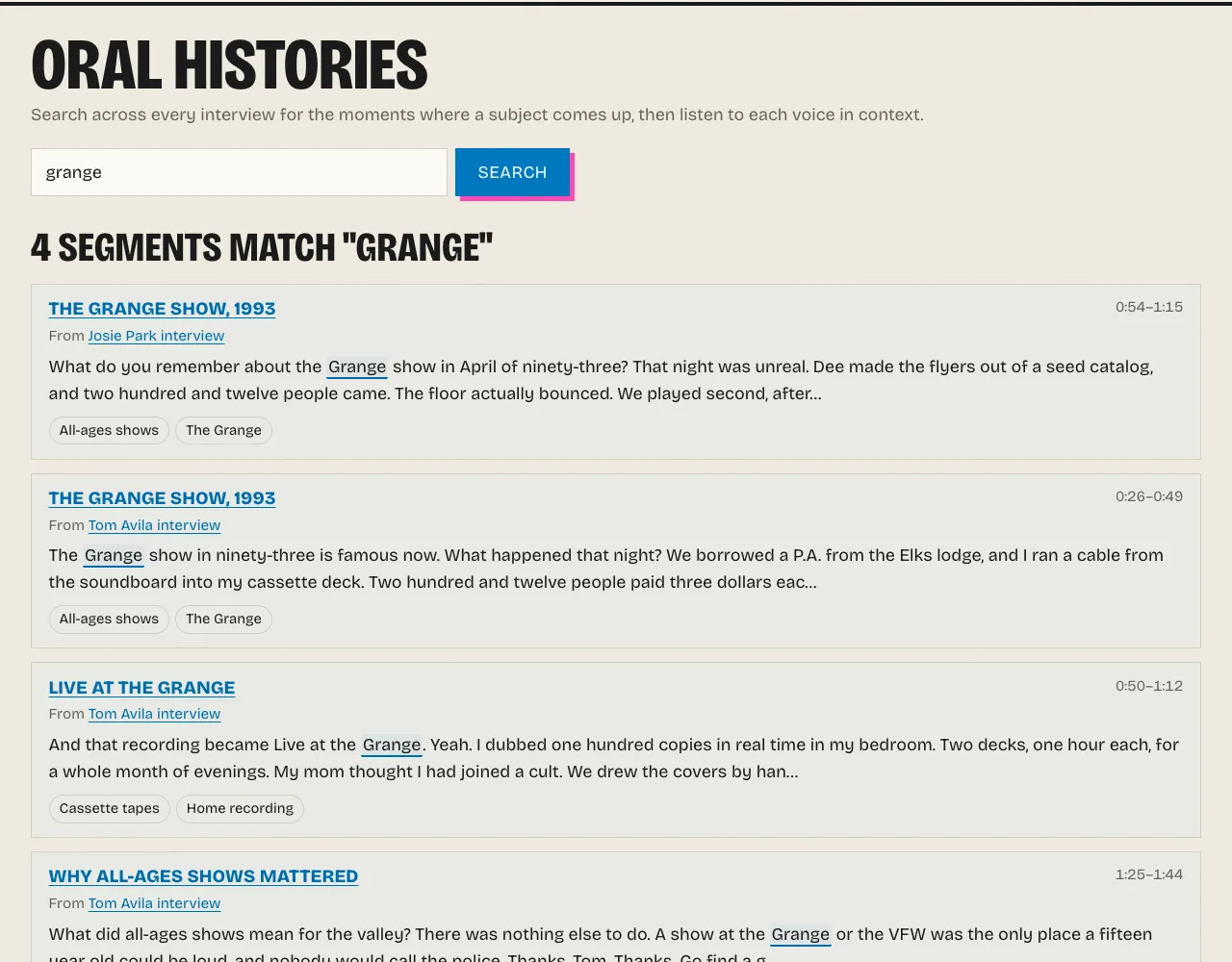
The pages
| Page | Address |
|---|---|
| Oral histories: segment search and the topic index | /oral-history |
| A topic: every segment on it, grouped by interview | /oral-history/topic/<topic> |
| A segment: its player, starting at the segment, with the previous and next segments of the interview | /oral-history/segment/<id> |
Only segments of published interviews whose item the visitor may see are listed. Link in the main navigation in the settings adds Oral Histories to the site's main navigation; order or rename it under Appearance > Navigation.
Segment search
The search matches chapter titles, topics and each chapter's own part of the transcript. "Grange" finds every segment in which anyone talks about it, and each result opens the segment page with playback at the chapter's start.
Topics
The language model suggests topics when an interview is segmented. It is given the topics already in use, so new interviews reuse established tags rather than inventing near-duplicates. Staff edit any chapter's topics on the review screen; a new label makes a new topic, and a topic no chapter uses any more disappears.
When an item has several interviews, the topic page adds each file's title to its group heading, so narrators are not mixed up.